



Hanoi is Vietnam’s capital and its political and cultural centre, a city of lakes, tree-lined boulevards and a thousand-year history that sits on the banks of the Red River in the north of the country. For expats it offers a lower cost of living than many Asian capitals, a growing choice of international schools, and housing that ranges from Old Quarter walk-ups to large lakeside apartments and suburban villas. This Hanoi overview covers the essentials for newcomers: geography, the new ward-based administrative map introduced in July 2025, population, the neighbourhoods where foreigners usually live, getting around (including the metro), and the climate.
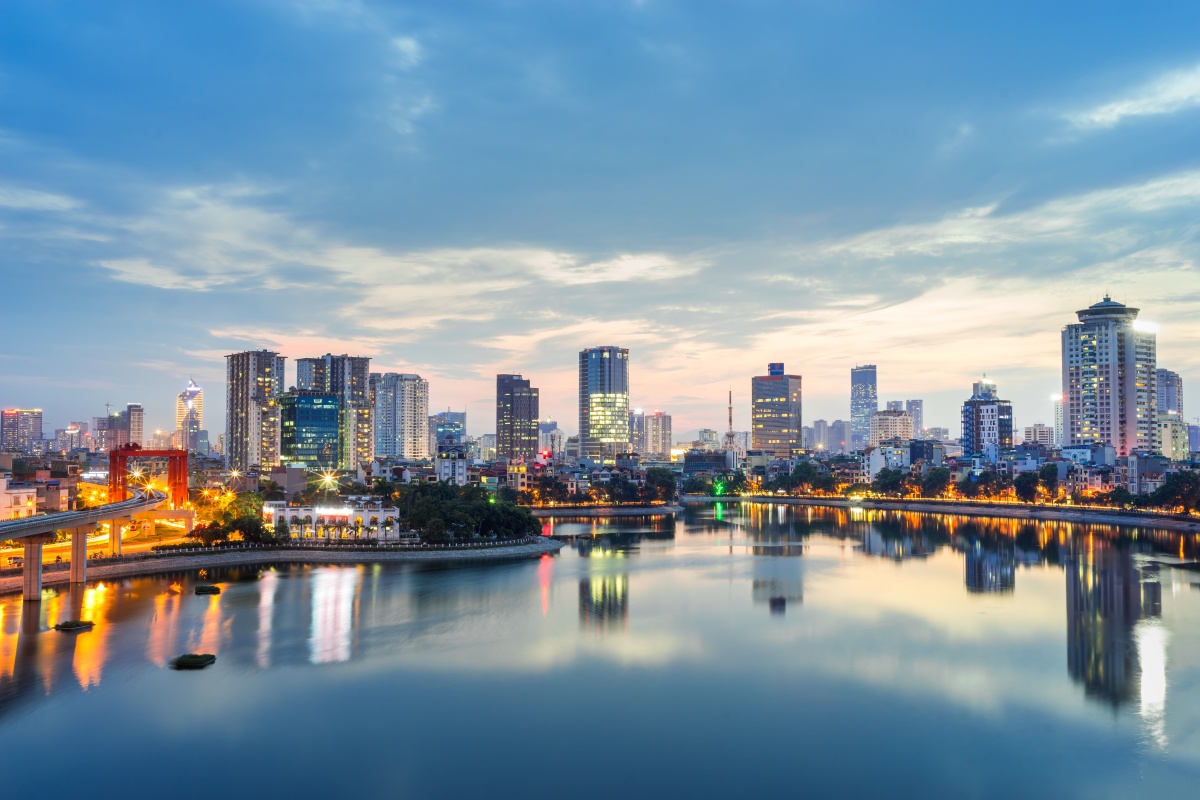
Hanoi geography at a glance
Hanoi covers about 3,360 km², stretching from the dense historic core around Hoan Kiem Lake out to rice fields, villages and the hills of Ba Vi in the west. The Red River runs through the city from north-west to south-east, and the urban area is dotted with lakes, the largest being West Lake (Ho Tay) in the north. When Vietnam reduced its provinces and centrally run cities from 63 to 34 in 2025, Hanoi was one of the units that kept its existing name and was not merged with a neighbouring province.
The practical result is a city with two very different faces. The inner area, roughly the former Hoan Kiem, Ba Dinh, Dong Da, Hai Ba Trung, Tay Ho and Cau Giay districts, is compact and walkable in parts, while the outer area is spreading quickly with new urban townships, ring roads and industrial zones. Most expat housing is concentrated in the inner area and in a handful of planned developments on its western and eastern edges.
Hanoi’s administrative map after the July 2025 reform
On 1 July 2025 Vietnam moved to a two-tier local government system, and the district level of administration was abolished nationwide. For Hanoi, the reorganisation was set out in Resolution 1656/NQ-UBTVQH15 of the National Assembly Standing Committee: the city’s former 30 districts, towns and 526 commune-level units were consolidated into 126 units, made up of 51 wards (phuong) in urban areas and 75 communes (xa) in rural areas. The city government now deals directly with these wards and communes.
For residents this mainly affects addresses and paperwork. Many familiar district names survive as ward names, but ward boundaries no longer match the old districts. The Old Quarter, for example, now falls mostly within Hoan Kiem ward, with the area around Hoa Lo in Cua Nam ward; the old Tay Ho district is now largely Tay Ho and Phu Thuong wards; and the former Ba Dinh district has been split into wards such as Ba Dinh, Ngoc Ha and Giang Vo. People still use the old district names in everyday conversation and in property listings, so you will see both. When signing a lease or registering residence, check that the address on documents uses the new ward name, and use street names and landmarks when giving directions to drivers.
Population and people
Hanoi has roughly 8.5–8.7 million residents according to recent official and industry estimates, making it Vietnam’s second-largest city after Ho Chi Minh City. About half the population lives in urban areas, and the city continues to grow as people move in for work and study. Residents are called Hanoians, Vietnamese is the language of daily life, and English is widely spoken in expat areas, international offices and many restaurants, though much less so in local markets and government offices.

Where expats live in Hanoi
Tay Ho (West Lake)
The area around West Lake, covering the new Tay Ho and Phu Thuong wards, has been the heart of Hanoi’s foreign community for well over a decade. It offers lake views, cafés and restaurants, international supermarkets, and a wide choice of serviced apartments, houses and villas, often at rents well below comparable areas in other Asian capitals. Teachers, pilots, diplomats and families are all well represented, and the Ciputra township in Phu Thuong ward is a popular choice for families thanks to its international schools. You can browse the Tay Ho area for current listings.
Ba Dinh, Kim Ma and the city centre
The former Ba Dinh district is Hanoi’s political centre and home to many embassies and offices. The Kim Ma and Lieu Giai area has long been popular with Japanese and Korean residents, with plenty of apartments close to offices and schools. The Old Quarter and the area around Hoan Kiem Lake are atmospheric and convenient for short stays, but long-term rents are relatively high and the streets are busy and noisy, so most long-term residents choose to live a little further out.

Cau Giay, Tu Liem and the west
The western side of the city, around the former Cau Giay, Nam Tu Liem and Bac Tu Liem districts, has many newer high-rise apartment buildings, offices, universities and international schools. It suits families and professionals who want modern facilities at more moderate prices, and large townships such as Vinhomes Smart City in the new Tay Mo ward offer full amenities on site. Students often live near the universities in Cau Giay and the former Dong Da district.
Long Bien and the east
Across the Red River, the Long Bien area offers more space and greenery, with townships such as Vinhomes Riverside and good access to the city centre via several bridges. It is a common choice for families who want a house or villa with a garden. For an overview of projects across all these areas, see our list of apartment buildings in Hanoi or browse serviced apartments in Hanoi.
Getting around Hanoi
Motorbikes remain the dominant form of transport, and traffic at peak hours can be heavy, so living close to work or school makes a big difference to quality of life. Ride-hailing apps for cars and motorbike taxis are widely used and easy for newcomers, and the city bus network, including electric buses, covers most districts at very low fares. Noi Bai International Airport lies north of the Red River and is typically 30–60 minutes from the centre by car, depending on traffic.
Hanoi now has two metro lines in operation. Line 2A (Cat Linh–Ha Dong), an elevated line with 12 stations, opened in November 2021 and runs south-west from the city centre towards Ha Dong. Line 3 (Nhon–Hanoi Station) has run on its 8-station elevated section between Nhon and Cau Giay since August 2024; the underground section on to Hanoi Railway Station is still under construction and is currently targeted to open in 2027. Together the two lines carried around 21 million passengers in 2025, and further lines are in planning, so the metro is becoming a realistic option for commuters living near a station.
Hanoi climate in brief
Unlike southern Vietnam, Hanoi has distinct seasons. Summers, roughly May to September, are hot and humid with heavy downpours, while winters from December to February are cool and often grey, and many homes have no central heating, so a heater or a two-way air conditioner is useful. Spring brings drizzle and high humidity, and autumn, around October and November, is widely considered the most pleasant time of year. For month-by-month details, read our guide to the Hanoi climate.
Key facts about Hanoi
- Status: capital of Vietnam, a centrally run city
- Area: about 3,360 km²
- Administrative units: 126 (51 wards and 75 communes) since 1 July 2025
- Population: roughly 8.5–8.7 million
- Time zone: Indochina Time (UTC+7), no daylight saving
- Language: Vietnamese
- Currency: Vietnamese dong (VND)
- City flower: lotus
Frequently Asked Questions
How many districts does Hanoi have?
Since 1 July 2025 Hanoi no longer has districts as an administrative level. The city is divided into 126 commune-level units, 51 wards and 75 communes, although the old district names are still widely used informally.
Where do most expats live in Hanoi?
The West Lake area (Tay Ho and Phu Thuong wards) has the largest foreign community. Ba Dinh and the Kim Ma area, the western districts around Cau Giay and Tu Liem, and Long Bien across the Red River are also popular, especially with families.
Does Hanoi have a metro?
Yes. Line 2A (Cat Linh–Ha Dong) has operated since November 2021, and the elevated section of Line 3 between Nhon and Cau Giay since August 2024. The underground section of Line 3 to Hanoi Railway Station is targeted for 2027.
What is the population of Hanoi?
Recent estimates put Hanoi’s population at roughly 8.5–8.7 million, making it Vietnam’s second most populous city after Ho Chi Minh City.
When is the best time of year in Hanoi?
Autumn, around October and November, is generally the most comfortable season, with milder temperatures and less rain. Summers are hot and humid, and winters can feel cold because most homes lack central heating.