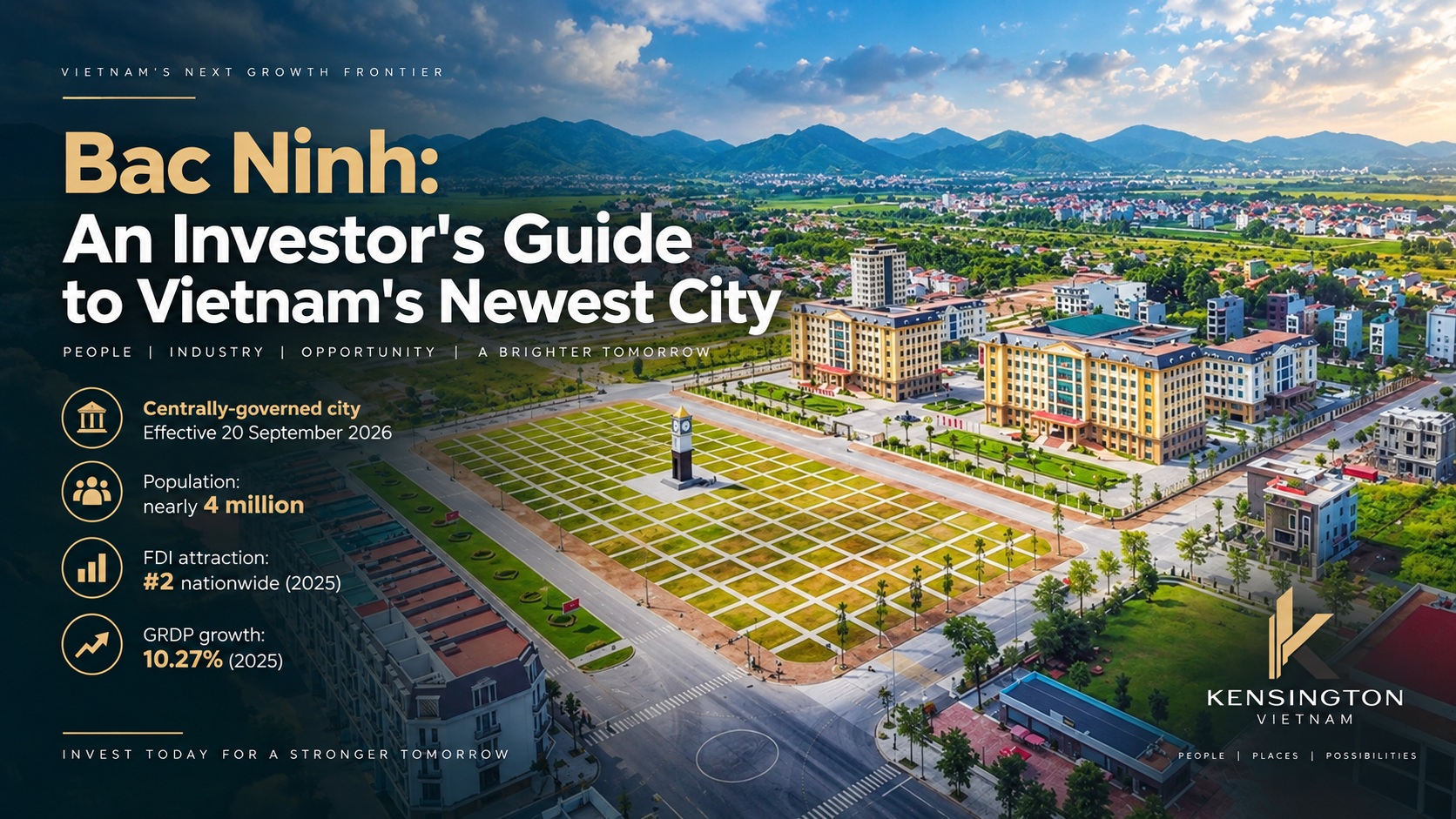
On 20 September 2026, Bac Ninh officially became Vietnam’s ninth centrally-governed city. The upgrade was made under Resolution No. 39/2026 of the 16th National Assembly. It puts Bac Ninh in the same administrative tier as Hanoi, Ho Chi Minh City, Hai Phong, Da Nang, Can Tho, Hue, Dong Nai and Quang Ninh.
For international investors, the change is more than a new title. Bac Ninh is already one of the North’s main manufacturing centres. Its new status comes with wider development powers, a long-term master plan and a new international airport under construction. Together, these reshape how investors should view the market.
Bac Ninh at a Glance
| Status | Centrally-governed city (effective 20 September 2026) |
| Area | 4,713.75 km² |
| Population | 3,989,623 (nearly 4 million) |
| Administrative units | 99 (45 wards, 54 communes) |
| Borders | Hanoi, Hai Phong, Hung Yen, Lang Son, Quang Ninh, Thai Nguyen |
| Economic size (2025) | 5th largest nationwide; 3rd in the Red River Delta |
| GRDP growth (2025) | 10.27% |
| FDI attraction (2025) | 2nd nationwide |
| State budget revenue (2025) | Over VND 123.6 trillion |
| Workforce | Over 830,000 workers (as of June 2026) |
Bac Ninh - The 9th City of Vietnam
The new status will let Bac Ninh:
- Expand its development space
- Strengthen its governance capacity
- Use its resources more effectively
- Deepen its links with the region and the world.
The Government’s stated goal is for Bac Ninh to become a high-tech, innovative, green, smart and modern industrial city. It also wants the city to be a growth pole for the region and the country, and to take part more deeply in global value chains.
For investors, this points to faster urbanisation, more public investment in infrastructure, and a larger role in the Capital Region economy.
Location and Connectivity
Bac Ninh sits at the northern gateway to Hanoi, inside the Capital Region. It is also part of the Hanoi – Hai Phong – Quang Ninh economic growth triangle. The city is a transport hub, with national road, rail and inland waterway networks.
Key connections
- Noi Bai International Airport and Hai Phong seaport, both within easy reach.
- Gia Binh International Airport, now under construction. This is a national strategic project. Its air traffic control tower is already rising.
- National Highways 1 and 18, plus Ring Roads 4 and 5, which link Bac Ninh to the wider Capital Region.
- Ongoing upgrades to main roads, boulevards, bridges and provincial roads.
Why Gia Binh matters
Gia Binh airport is the boost to regional connectivity. If the airport connects well to factories, logistics hubs, seaports and urban areas, it could become a new link in the northern supply chain. Shorter transit times and more international routes would make the region more attractive to investors. This matters most for high-tech manufacturers, which depend heavily on good logistics.
Economy and Industry
Bac Ninh is best known as a centre for electronics and high technology. It also has modern logistics and large-scale agriculture.
Global manufacturers. Major companies operate here, including Samsung, Foxconn, Luxshare, Goertek and Amkor. According to the local press, these firms are all scaling up operations as the city aims for double-digit growth in 2026.
Agriculture. Bac Ninh’s lychees are a well-known export product. The 2026 lychee season set a record, with revenue from lychees and related services estimated at more than VND 9,000 billion.
The Master Plan to 2050, Vision to 2075
The Prime Minister recently approved the Bac Ninh urban master plan to 2050, with a vision to 2075. It sets two long-term goals:
- By 2050: a modern, smart city that is highly competitive within Asia.
- By 2075: an internationally recognised megacity and a northern centre for the economy, innovation and trade.
The plan also defines distinct roles for the city’s main urban areas:
- Bac Giang will be a comprehensive central urban area. It will host politics, administration, the economy, culture and education.
- Kinh Bac will be a comprehensive economic growth pole. It will follow an innovative, public-transport-oriented urban model, built around the Quan Ho folk music heritage.
Three Strategic Priorities
The city’s leadership has set out three strategic breakthroughs:
- Infrastructure and urban space. Complete strategic infrastructure and plan a green, smart, modern city. Transport and logistics, especially Gia Binh Airport, are central to expanding development space and competitiveness.
- Technology and innovation. Make science, technology, innovation and digital transformation the new drivers of growth. Priority sectors are high-tech industry, semiconductors, AI and the digital economy, supported by an innovation ecosystem and a skilled workforce.
- Governance. Build a digital, modern government. Service quality will be measured by the satisfaction of citizens and businesses.
Workforce and Housing
Bac Ninh has more than 830,000 workers, many of them migrants from other provinces. The city keeps investing in social housing and worker housing near major industrial and urban zones, to give hundreds of thousands of workers stable homes. Workers are also building their skills and learning foreign languages. For example, employees of Samsung Display Vietnam study Korean in their dormitories.
Culture and Lifestyle
Bac Ninh is the heartland of Kinh Bac culture. The city has committed to growth that preserves its cultural identity.
- Quan Ho folk songs were inscribed by UNESCO as Intangible Cultural Heritage of Humanity on 30 September 2009.
- 9 special national relics, including Phat Tich, Dau, But Thap, Bo Da and Vinh Nghiem pagodas, Do Temple, the Yen The Uprising site and the Xuong Giang Victory site.
- Traditional festivals, including Lim, Den Do, Chua Dau and Yen Tu.
- Nature and spiritual tourism, including Tay Yen Tu, Dong Cao, Cam Son Lake and Khuon Than Lake.
The city also plans cultural and tourism villages built around traditional architecture, craft villages and Quan Ho spaces.
- Industrial and logistics property. An FDI base ranked 2nd in the country, a pipeline of expanding global manufacturers and a new international airport all support long-term demand for factories, warehouses and logistics facilities.
- Rental and workforce housing. More than 830,000 workers, many from other provinces, create steady demand for rental housing. This includes housing for skilled staff and foreign experts working for FDI companies.
- Urban residential. City status, the 2050 master plan and the conversion of communes into wards all point to continued urbanisation. The Kinh Bac growth pole and areas around Gia Binh Airport are worth watching.
- Hospitality and tourism. Strong heritage and nature assets support hotel, serviced apartment and resort opportunities, especially once airport access improves.
Bac Ninh combines:
- A proven industrial economy (5th nationwide, 10.27% GRDP growth in 2025)
- A strategic location between Hanoi and the northern seaports
- A major new airport under construction
- A clear government roadmap to 2075.
Its new status as Vietnam’s ninth city marks the start of its next phase of growth. That makes it one of the most important markets in Northern Vietnam for real estate investors to watch.
Two Investment Hotspots in Bac Ninh
The new city has two main urban centres. They offer investors two different propositions. Vo Cuong and Kinh Bac offer the security of a proven market next to Hanoi. Tan Tien and Bac Giang offer the upside of a new city centre at an earlier, more affordable stage. Many investors may choose to hold assets in both.
1. Vo Cuong & Kinh Bac Wards - The Established Core
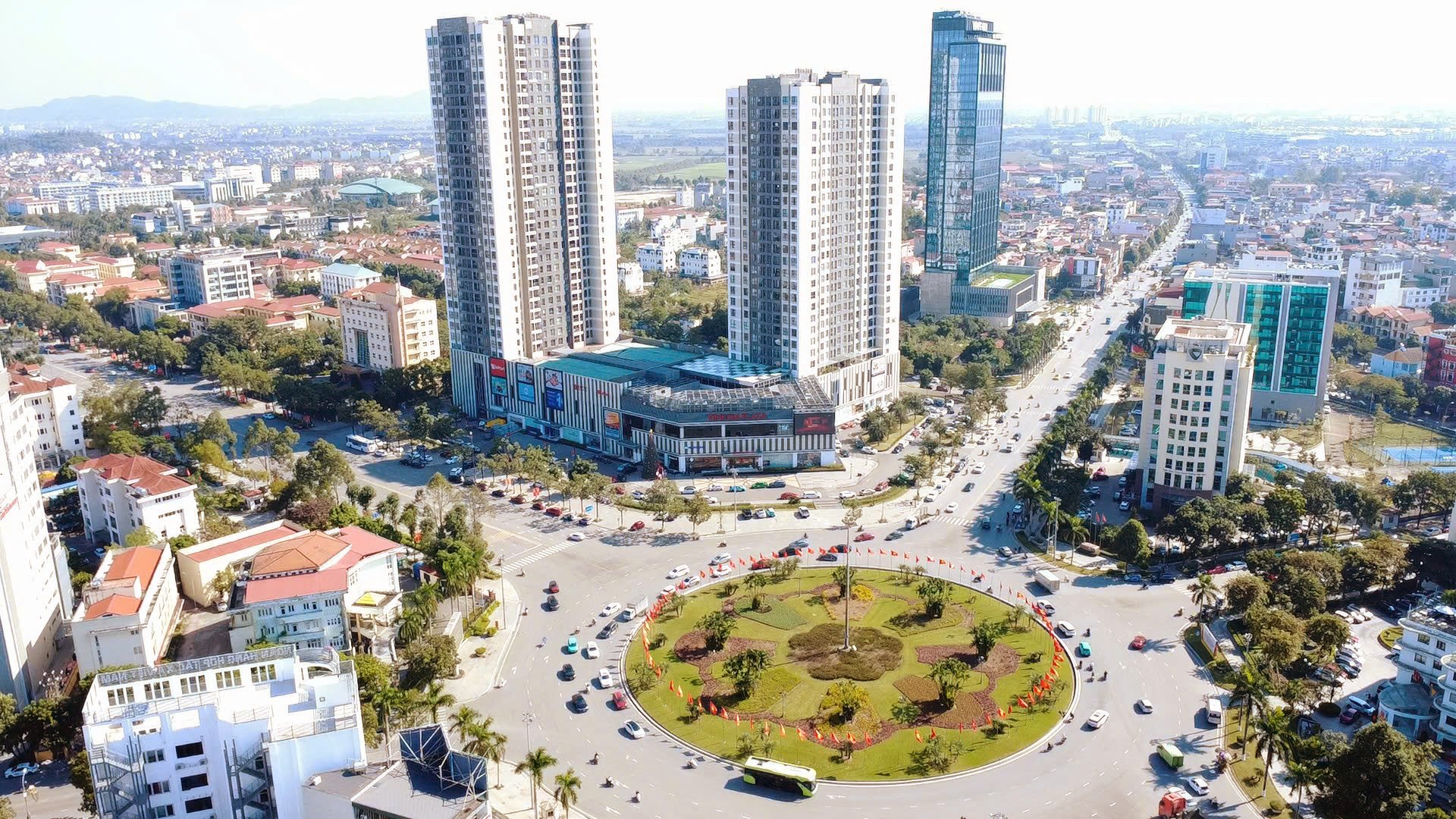
The former Bac Ninh city centre. A mature urban area with proven demand. This is the historic heart of Bac Ninh. It is the most developed part of the new city, with established infrastructure, schools, hospitals, retail and services already in place. It also has a large, dense population.
Its biggest advantage is location. The area sits very close to Hanoi, which makes it practical for people who live in one city and work in the other. It is also well connected to the industrial parks where global manufacturers such as Samsung and Foxconn operate.
Under the 2050 master plan, Kinh Bac is designated as the city’s comprehensive economic growth pole. It will follow an innovative, public-transport-oriented urban model, rooted in the area’s Quan Ho cultural heritage.
- Fully developed infrastructure and amenities
- Large existing population and strong rental demand
- Excellent proximity to Hanoi
- Designated economic growth pole in the master plan
Consideration: Prices here are already relatively high, which reflects the area’s maturity. This market suits investors who want stability, liquidity and immediate rental income, rather than early-stage upside. Best for rental income, lower-risk entry, and buyers who want a ready-to-live environment.
2. Tan Tien & Bac Giang Wards - The New Administrative Centre
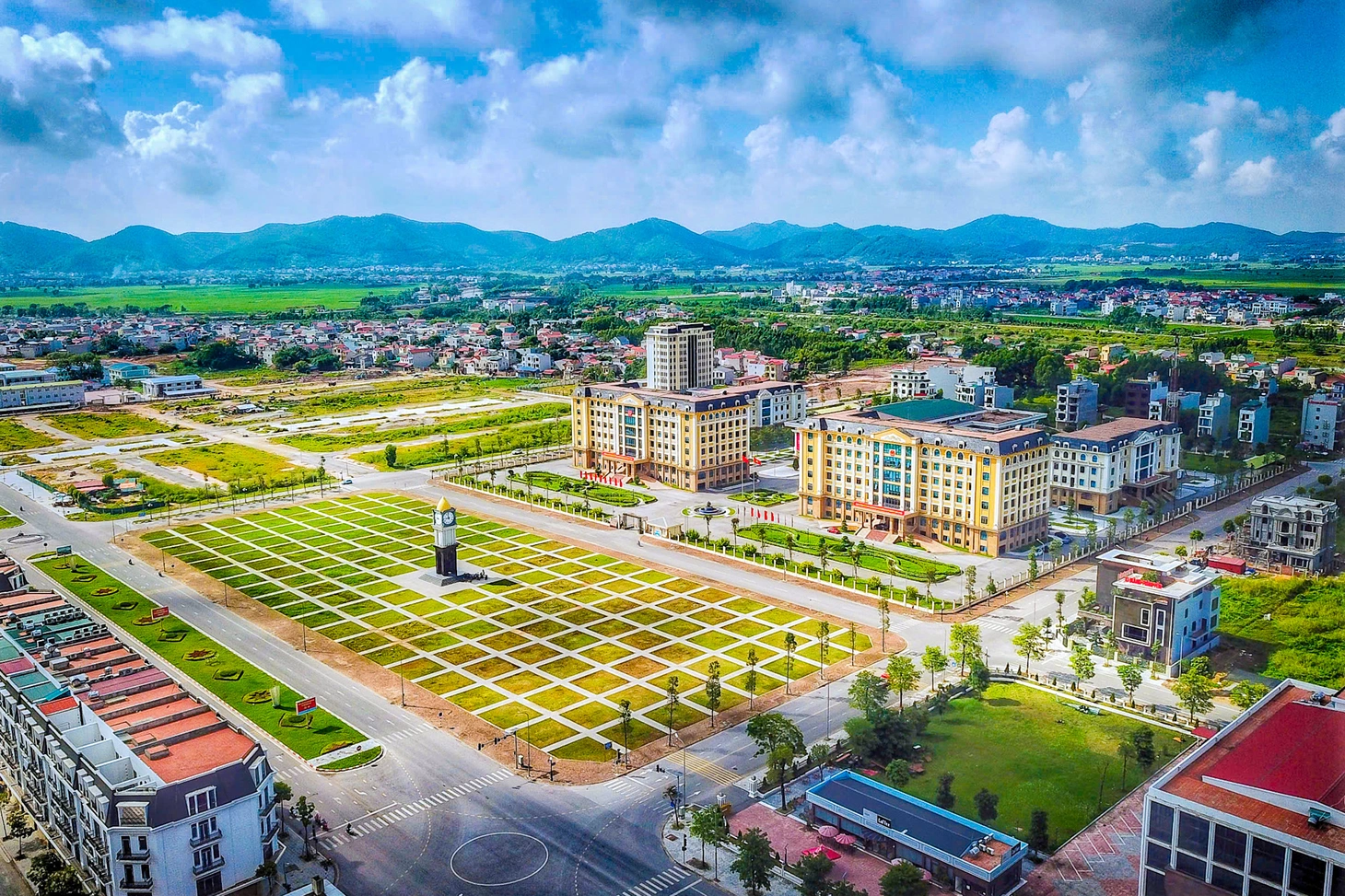
The new political and administrative heart of Bac Ninh city, located in the former Bac Giang province.
This is where the city’s governing institutions are based. The headquarters of the Bac Ninh Party Committee is located in Tan Tien ward. The master plan designates Bac Giang as the city’s central urban area, covering politics, administration, economics, culture and education.
The area is being developed largely from scratch. That means modern, well-planned infrastructure: wide boulevards, organised land use and newly built public facilities. Entry prices are noticeably more accessible than in the established core.
Key strengths
- Brand-new, master-planned infrastructure
- Seat of the city’s political and administrative institutions
- More affordable entry prices
- Strong long-term growth potential as government agencies, services and residents relocate
- Brand-new, master-planned infrastructure
- Seat of the city's political and administrative institutions
- More affordable entry prices
- Strong long-term growth potential as government agencies, services and residents relocate
Consideration: As a newer area, its population and amenities are still growing. Investors should take a medium- to long-term view. Best for: Capital-growth investors and early movers seeking value ahead of the city’s expansion.
The Projects in Bac Ninh
Foreign ownership is only permitted in eligible projects, so the choice of available projects differs sharply between the two hotspots. In Vo Cuong and Kinh Bac wards, Vinhomes King Park is currently the only project where foreigners can buy. Supply in the established core is therefore very limited for international investors. Tan Tien and Bac Giang wards offer a wider range: Eco Garden in the mid-range segment, and Royal Mansion and MIK Bac Giang at the high end segment. For foreign investors, the new administrative centre gives more choice at more accessible prices. The established core offers a single, scarce option in Bac Ninh’s most mature urban area. Check all properties in Bac Ninh.