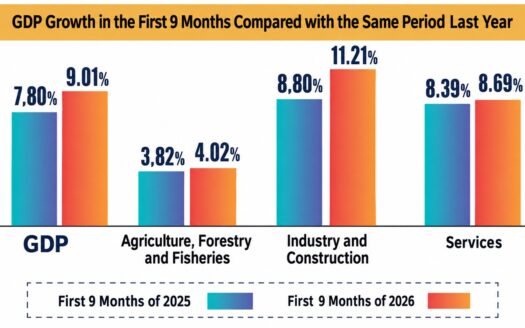

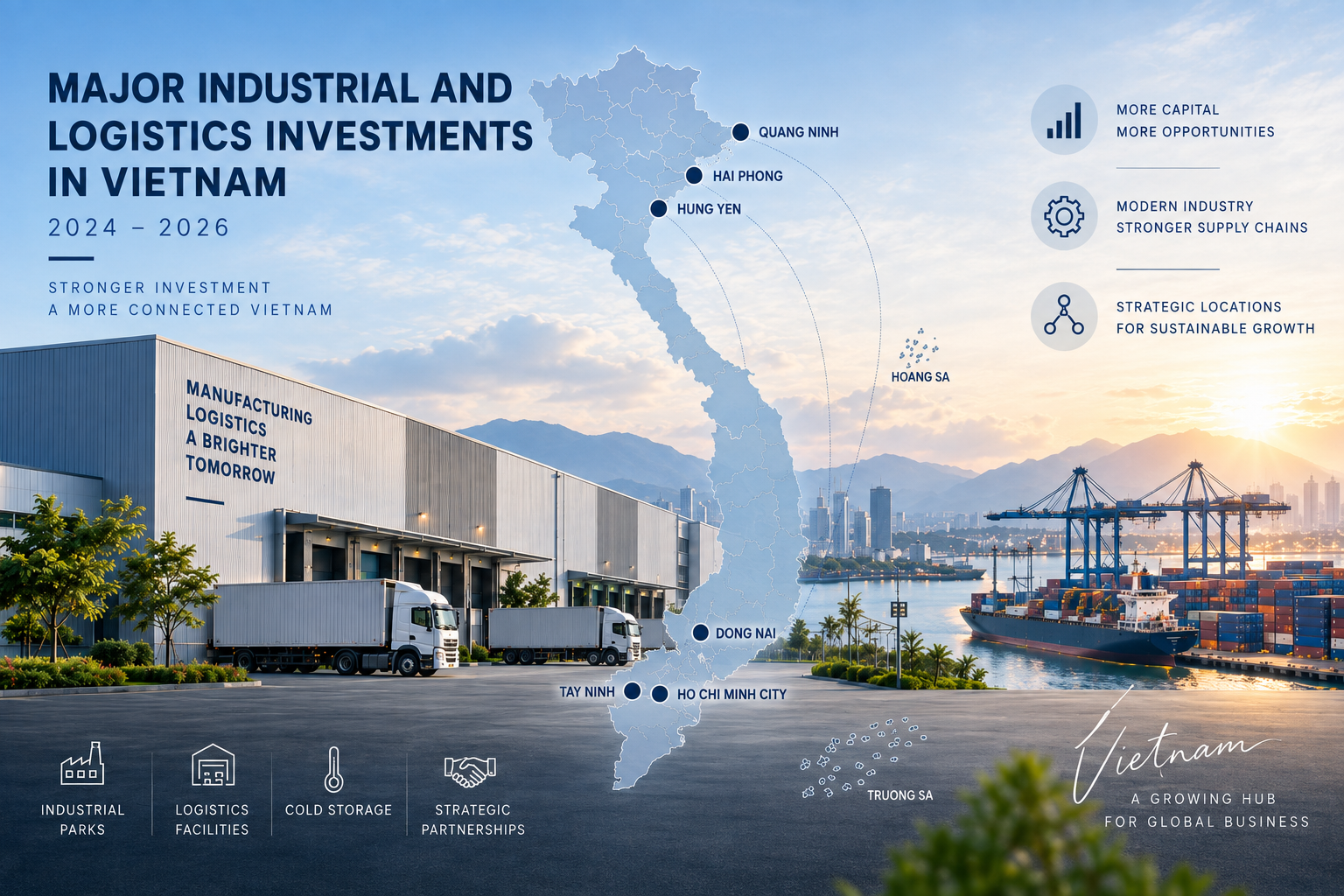
Vietnam’s industrial real estate market may be entering its first major capital restructuring cycle. A generation of ready-built factory and warehouse portfolios developed since around 2018 is now reaching maturity, creating opportunities for larger asset transactions and greater participation from foreign institutional investors.
Manufacturing Growth Drives Demand for Industrial Real Estate
According to John Campbell, Director and Head of Industrial Services at Savills Vietnam, the country has recorded a number of industrial real estate transactions, but has yet to see many large-scale portfolio sales comparable to those in more developed markets such as Singapore.
Since 2018, Vietnam has seen a growing number of developers investing in high-quality ready-built factories and warehouses for lease. Many of these assets are now reaching a more mature stage, having built up stable occupancy over five to ten years.
As these portfolios become more established, owners may begin considering the sale of stabilized assets or entire portfolios, allowing them to recycle capital into new developments and investment opportunities.
Vietnam’s industrial real estate story has so far been closely tied to the country’s rise as a manufacturing destination.
According to data from the General Statistics Office, foreign investment into Vietnam reached USD 34.65 billion in the first half of 2026, up 61% year on year. Manufacturing alone attracted around USD 18.47 billion, including USD 10.71 billion from newly registered projects.
At the same time, the number of new manufacturing projects fell from 759 in the first half of 2025 to 468 in the same period of 2026. This suggests that investment is becoming concentrated in fewer, but larger, projects.
Lance Li, CEO of BW Industrial, one of Vietnam’s major developers of industrial and logistics properties for lease, said manufacturers are taking a longer-term view of the Vietnamese market.
“Many companies, regardless of where they come from, are expanding into Vietnam as part of their China+1 and supply-chain resilience strategies. Vietnam complements their existing operations elsewhere rather than replacing any particular market,” he said.
Investment Shifts Toward Larger, Higher-Value Manufacturing Projects
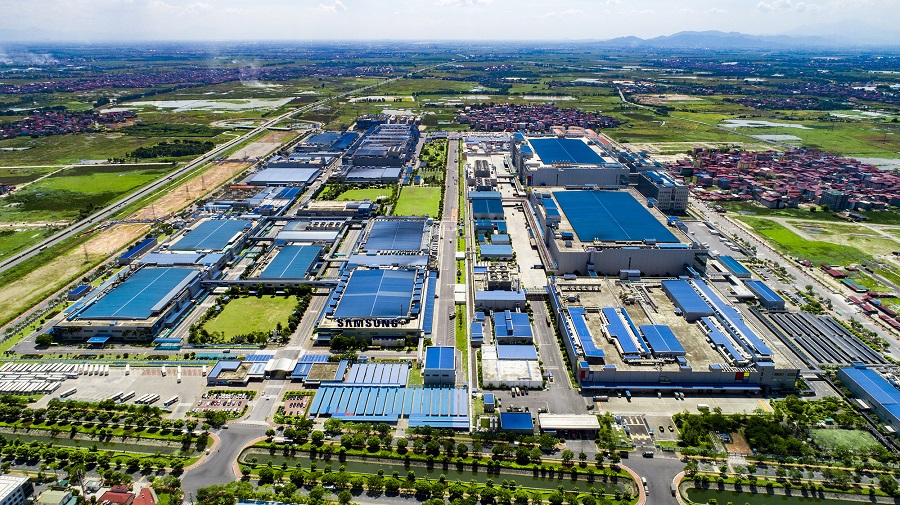
Yen Phong Industrial Park in Bac Ninh
The type of manufacturing investment is also changing. Vietnam is no longer attracting only footwear, garment and textile manufacturers. Electronics and semiconductor projects are now playing a much larger role.
Newly registered FDI related to the electronics sector jumped to around USD 7.03 billion in the first six months of 2026, compared with USD 984.5 million in the same period a year earlier, even as the number of new electronics projects fell from 99 to 65.
The three largest manufacturing investments alone accounted for approximately USD 6.36 billion, equivalent to nearly 60% of all newly registered manufacturing investment during the period.
Campbell said the shift toward larger projects means manufacturers are no longer looking only at available space and land prices when choosing a location. They are also paying closer attention to workforce quality and broader supply-chain considerations.
Of the 468 newly registered manufacturing projects in the first half of 2026, 266 were factory projects, representing USD 7.09 billion, or 66.24% of total newly registered FDI in manufacturing.
In northern Vietnam, factory projects accounted for around 73% of total newly registered manufacturing investment.
Industrial Real Estate Transactions Are Gaining Momentum
The expansion of Vietnam’s industrial base has been accompanied by growing merger and acquisition activity, as well as equity fundraising across the sector.
Nguyen Thi Vinh Ha, Head of Advisory and Deputy General Director at Grant Thornton Vietnam, said the firm recorded 24 announced and completed real estate M&A and equity fundraising transactions in the first nine months of 2025, with a total value of around USD 1.8 billion.
“Industrial real estate accounted for 55%, or approximately USD 1 billion. This was significantly higher than the full-year figure for 2024, when only seven industrial real estate transactions were recorded, with a disclosed value of around USD 90 million,” Ha said.
Foreign real estate investment funds, domestic industrial developers and large corporations were active between 2024 and 2026, using a range of investment structures. These included equity fundraising, acquisitions of shares in project companies, and direct transfers of assets and projects.
Ha said: “Acquisition-led expansion is becoming a more prominent strategy, allowing investors to shorten development timelines, make use of existing infrastructure, optimize capital deployment and bring assets into operation more quickly.”
Major Industrial and Logistics Real Estate Transactions and Investments in Vietnam, 2024–2026
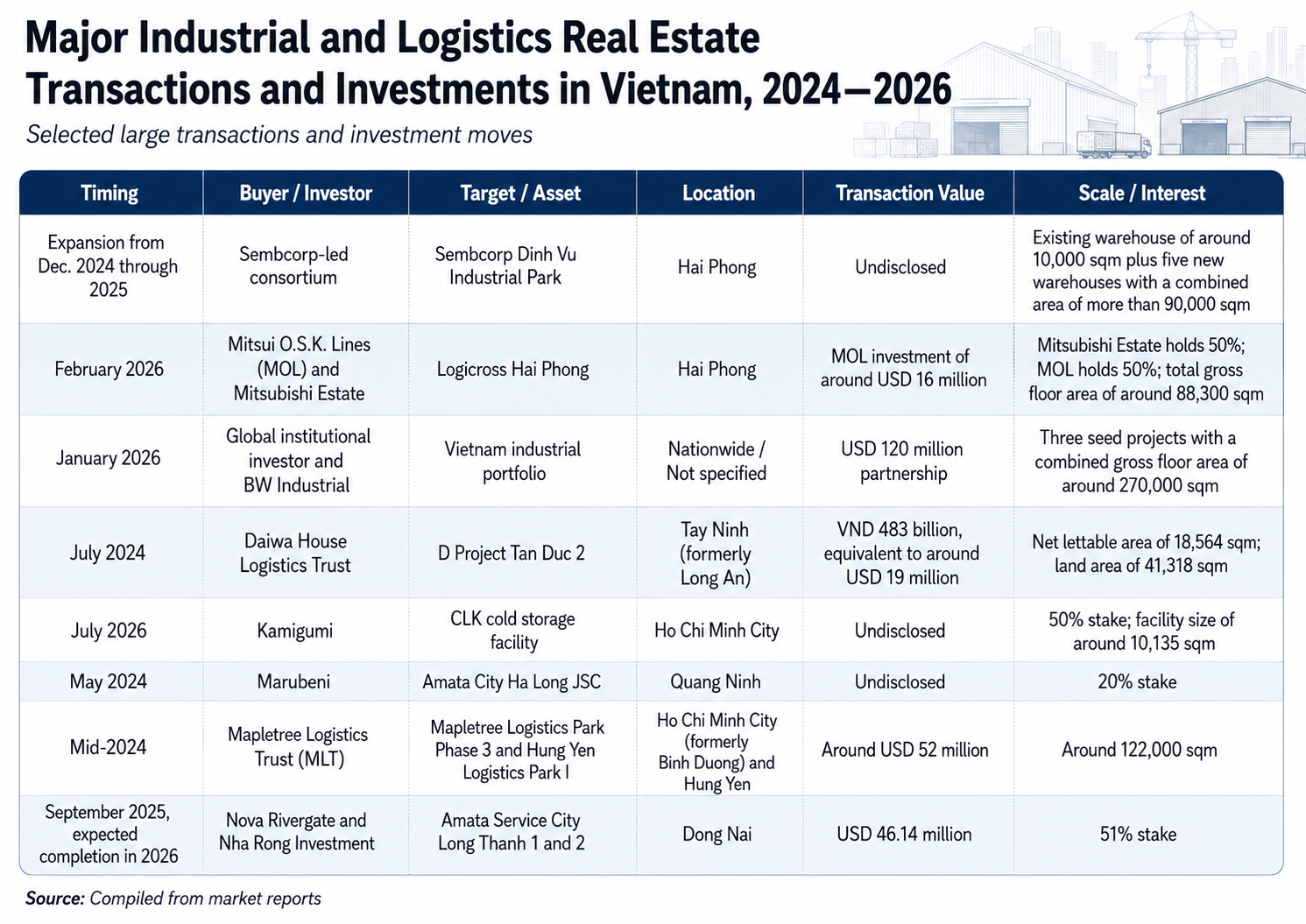
Major industrial and logistics real estate transactions in Vietnam have increased noticeably since 2024, involving both foreign institutional investors and major industrial developers. Deals have ranged from direct asset acquisitions and equity stakes to large-scale portfolio partnerships, with transaction values reaching tens or even hundreds of millions of US dollars. Most activity has focused on key manufacturing and logistics hubs such as Hai Phong, Hung Yen, Dong Nai, Ho Chi Minh City, Tay Ninh and Quang Ninh, covering warehouses, industrial parks, logistics facilities and cold storage assets. The growing size and variety of these transactions reflect stronger investor interest in Vietnam’s industrial real estate market and a shift toward larger, more institutional-scale investments.
Investors Seek Larger Industrial Portfolios
One of the biggest constraints in Vietnam’s industrial real estate market remains scale. Campbell said the country has a growing supply of individual factories and smaller groups of industrial assets that could potentially be sold, but large investment funds typically look for aggregated portfolios.
“For investors seeking scale, Vietnam needs more consolidated portfolios of modern factories, warehouses and logistics assets, rather than individual properties spread across different locations,” he said.
Since 2018, Vietnam has developed a broader ecosystem of modern factory and warehouse developers. However, having more high-quality developers does not automatically create a highly liquid institutional investment market. The mismatch between the size of individual assets available for sale and the amount of capital large funds need to deploy helps explain why Vietnam has yet to see a broader wave of industrial portfolio transactions.
For investors entering Vietnam for the first time, portfolios with high occupancy rates, international tenants, transparent lease agreements and professional management are likely to be among the most attractive opportunities for future transactions. Manufacturers could provide another source of institutional-grade assets through sale-and-leaseback transactions.
Under this structure, a manufacturer sells its property to an investor and then leases it back, allowing the company to release capital tied up in real estate while continuing to operate at the same location. Campbell said manufacturers can use the released capital to invest in machinery, automation or expansion, while investors gain access to income-producing assets backed by long-term leases.
“Instead of going to a bank and borrowing at a high interest rate, they can sell their factory and immediately lease it back. This allows them to unlock capital while continuing to operate from the same facility and paying rent,” he said.