




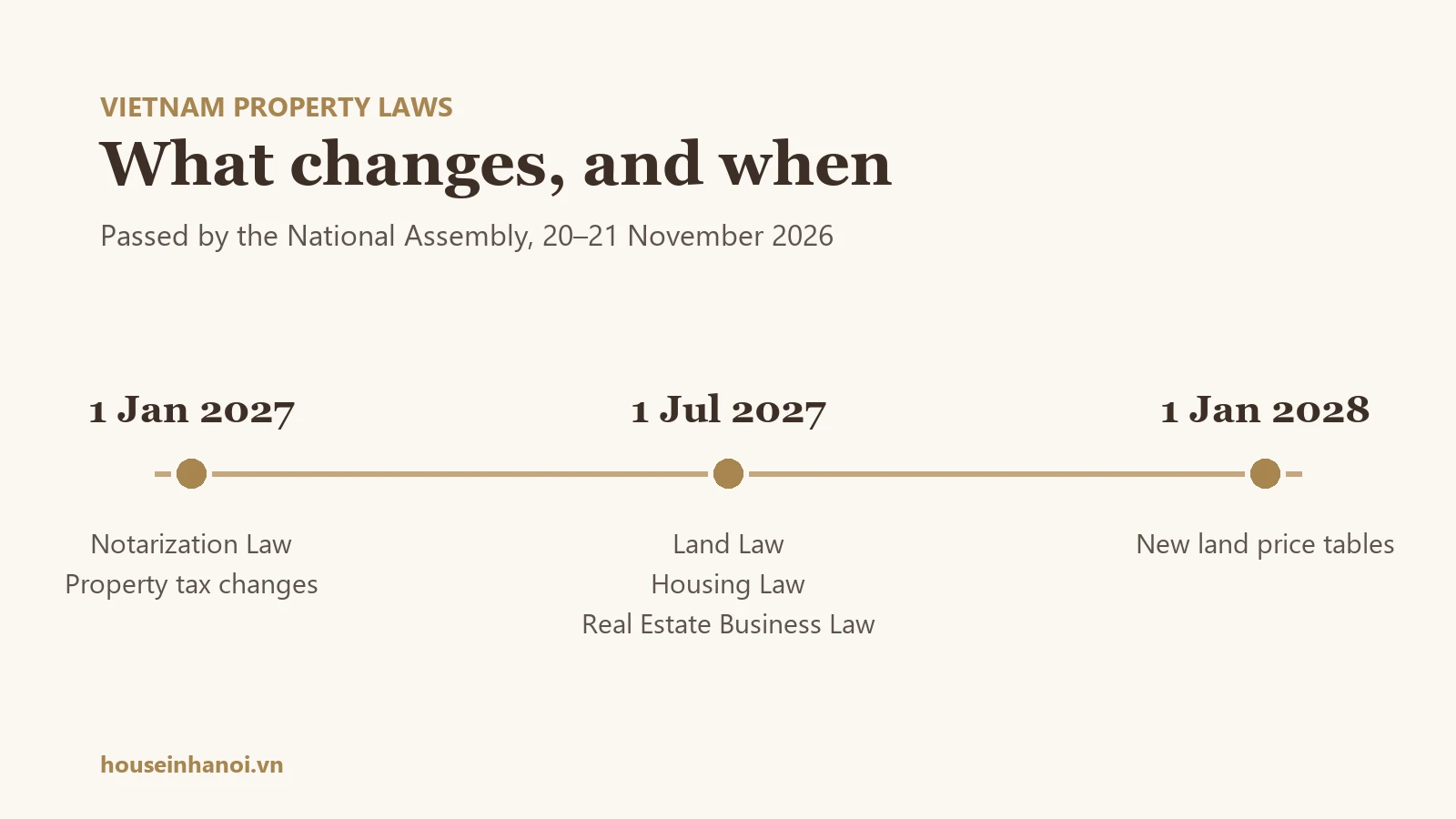
Vietnam’s National Assembly passed new versions of the Land Law, Housing Law and Real Estate Business Law on 21 November 2026, a day after approving tax changes that affect property. Most of the new rules take effect on 1 July 2027.
For buyers, three changes stand out. Developers will be able to take a deposit of no more than 5%, and only once a project is legally ready for sale. Apartments can be rented out for short stays, which the current law does not allow. And apartments remain open to foreign buyers, within the existing cap of 30% per building.
Key Dates
| Date | What takes effect |
|---|---|
| 1 January 2027 | Amended Notarization Law; most of the amended tax law |
| 1 July 2027 | Amended Land Law, Housing Law and Real Estate Business Law; new tax rates on idle and misused land |
| 1 January 2028 | New provincial land price tables and price adjustment coefficients |
Land prices used to calculate state fees will follow the current rules until the new provincial price tables take effect in 2028.
Safer Off-Plan Purchases
Most new apartments in Hanoi are sold off-plan, and the amended Real Estate Business Law tightens how developers collect money from buyers. It ends the practice of taking “booking” fees before a project is approved for sale, which became common in recent years and is explained in our guide to how booking works.
- No early money. Developers may not collect money in any form to secure a contract before the project is legally ready for sale
- Deposit. Capped at 5% of the price, and it counts toward the first payment
- First payment. No more than 30% of the contract value, deposit included
- Before handover. No more than 70% in total (50% in some cases where the seller is a foreign-invested company)
- Before the title. No more than 95% until the buyer receives the ownership certificate
- Paperwork. The developer must apply for the buyer’s certificate within 50 days of handover or full payment
Apartments can be sold off-plan only once the foundations are finished and signed off, and the developer must notify the provincial real estate authority in writing first. Only the developer can sign deposit and sale contracts, not brokers or other companies acting for it.
Before selling, developers must also publish the project’s legal documents, any mortgages or disputes, and their standard contracts on the national housing and real estate information system. Every home and land plot will get an electronic ID code used in all transactions, so buyers can check exactly what they are paying for. Developers must fund at least 20% of a project from their own equity, or 15% for projects of 20 hectares or more.
Buying off-plan from abroad
Many foreign buyers sign for an apartment long before the building is finished. Under the new rules, no more than 5% goes in as a deposit, payments follow construction, and the last 5% is held back until the ownership certificate is issued. Each project’s legal details will also be public on the national system. The rules apply from 1 July 2027.
What It Means for Foreign Buyers
According to the Government’s report to the Assembly, foreign individuals permitted to enter Vietnam can own apartments. So can branches and representative offices of foreign companies, foreign investment funds and branches of foreign banks. Foreign-invested companies keep the rights they had under the 2023 Housing Law, and foreign ownership stays capped at 30% of the apartments in each building.
Villas and townhouses are less certain. A draft published in September removed the right for foreigners to buy landed homes in projects, which the current law allows up to 250 homes in an area the size of a ward. Reports on the passed law mention apartments only, so anyone considering a villa should wait for the final text. Our guides explain the Pink Book for foreigners and why some apartments cannot be sold to foreigners.
Short-Term Rentals in Apartments
The Housing Law also opens the door to short-term rentals in apartments. Using an apartment for non-residential purposes is still banned, but the new law makes an exception for renting it out as a home or for short stays. The 2023 law had no such exception, and many buildings had posted notices saying daily rentals were illegal. Lawmakers also removed the words “short-term” from the final text, which Tuoi Tre and industry groups read as covering stays from one night to several months.
Government decrees will set out which apartments qualify, fire safety requirements and how guests are managed. Hosts will still need to declare guests’ stays to the local police and pay tax on rental income. Once those rules are in place, owners who buy to let should be able to choose between long leases and short stays.
Higher Costs for Idle Land
From 1 July 2027, abandoned land is taxed at 0.2% a year with no tax-free allowance, land used for the wrong purpose at 0.15%, and land in approved phased projects at 0.03%. Projects that fall behind schedule will also pay an extra land fee on the delayed area until it is used, unless the delay is caused by force majeure. Developers who sit on land will pay for it, which should push more projects into construction.
Other Changes
Older apartment buildings. A building’s service life now follows its design. When it reaches the end, it must be inspected, and if it cannot be made safe it will be demolished and rebuilt through a formal project. Owners in buildings completed in 1994 or earlier can choose a resettlement or social housing unit, cash or land use rights. Owners in newer buildings can contribute to the rebuild or transfer their rights.
Social housing. After five years, social housing can be resold only to buyers who are themselves eligible for it.
Rental housing. Provinces must give priority to land for rental homes near transit lines, industrial zones and universities, and private investors get land fee exemptions, tax incentives and preferential loans.
Land titles and notarization. More households with long-standing paperwork problems will be able to get land use certificates, and land owned jointly by a married couple must carry both names. The Government will publish a list of land transactions that must be notarized, under the amended Notarization Law that starts on 1 January 2027.
What Happens Next
For buyers, the changes mean less money at risk before a building is finished, more public information about each project, and a legal way to rent out an apartment by the night. The Government will issue decrees over the coming months to fill in the details, from how short-term rentals are managed to which transactions need a notary.
Until July 2027, purchases follow the current rules, which our Buyer’s Guide explains. We will update this article when the full texts and decrees are published.
Based on reporting by VietnamFinance, Bao Xay Dung, Bao Dau Thau, Market Times, VietnamPlus and Tuoi Tre, 21–22 November 2026.