The Ultimate Guide to Hanoi's 100-Year Master Plan
Everything You Need to Know About the Future of Vietnam's Capital
For decades, Hanoi has grown faster than its infrastructure could keep up. Traffic congestion, fragmented urban expansion, and mounting pressure on the historic city center have become familiar challenges for one of Southeast Asia’s fastest-growing capitals.
- Now, that may be about to change.
In June 2026, the Hanoi People’s Committee officially unveiled the 100-Year Master Plan – the city’s most ambitious urban blueprint to date. Rather than focusing on a single downtown core, the plan reimagines Hanoi as a network of connected urban centers linked by one of Asia’s largest metro systems, new airports, green corridors, and large-scale mixed-use districts.
Whether you’re an investor, a future resident, a business owner, or simply curious about Hanoi’s future, this guide brings together the key ideas behind the master plan and explains why they matter.
This article gives you the big picture. Throughout the guide, you’ll also find links to deeper articles covering metro development, West Lake, the Red River, transit-oriented development (TOD), and the investment opportunities created by the plan.
1. Hanoi's 100-Year Master Plan in 60 Seconds
If you only have one minute, here are the highlights.
| Category | At a Glance |
|---|---|
| Official Plan | Hanoi 100-Year Master Plan (Decision No. 2512/QĐ-UBND) |
| Coverage | Entire Hanoi – approximately 3,360 km² |
| Administrative Area | 126 wards and communes |
| Long-term Vision | A globally connected, green and innovative capital city |
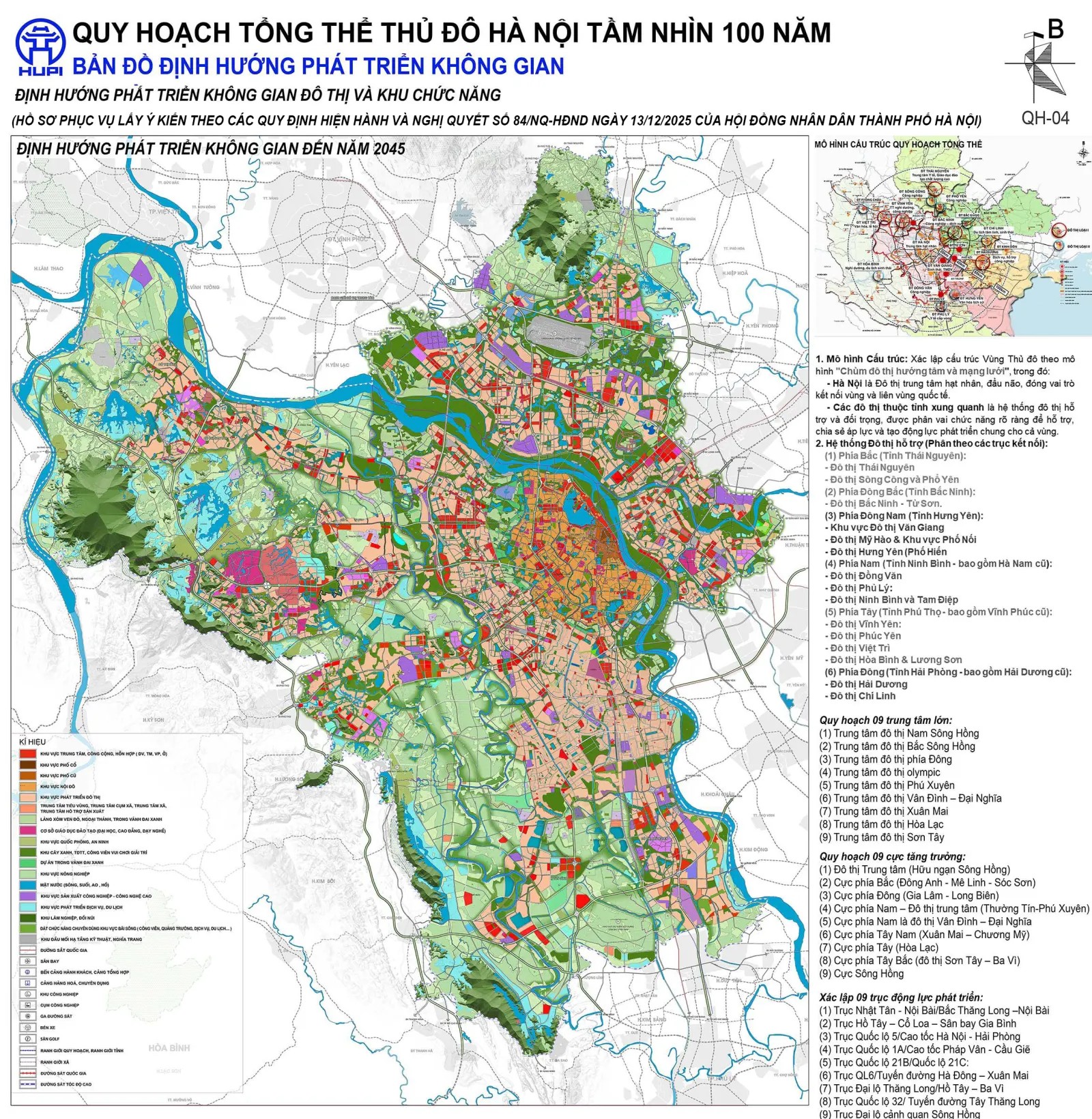
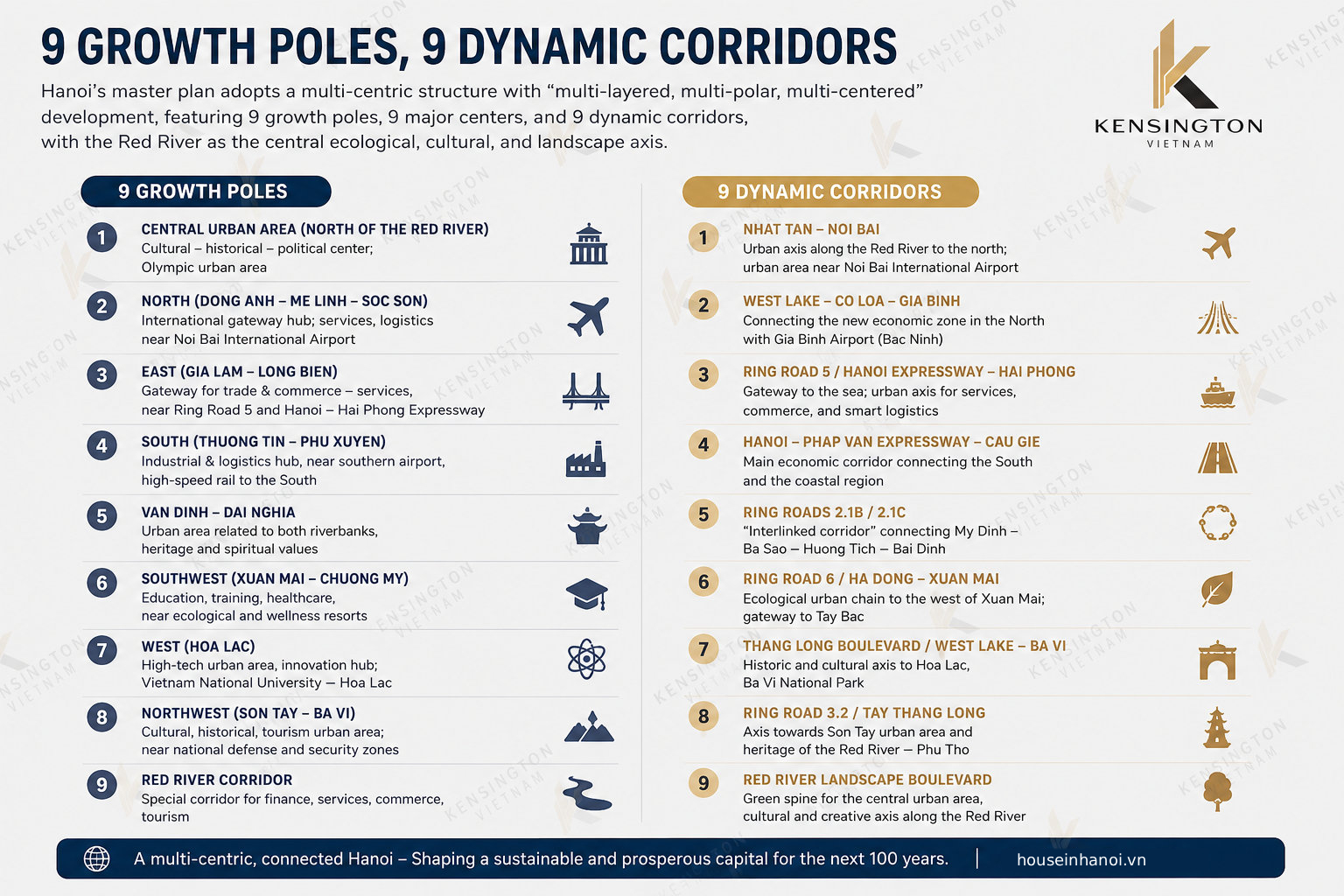
| Planning Structure | 9 growth poles • 9 major urban centers • 9 development corridors |
| Metro Network | Up to 1,200 km planned by 2065 |
| International Airports | Expanded Noi Bai + one new international airport in southern Hanoi |
| Population Capacity | Infrastructure designed to support 22–25 million people |
| Target Population | Approximately 17–19 million by 2065 |
| Economic Goal | Around US$1.9 trillion GRDP by 2065 |
In one sentence: Hanoi is shifting from a single city center into a connected metropolitan region built around public transport, green infrastructure, and multiple economic hubs.
2. What Will Actually Change?
If the vision is delivered over the coming decades, Hanoi won’t simply become a larger city, it will become a fundamentally different one.
One of Asia's Largest Metro Networks
The city plans to expand its urban railway system to approximately 1,200 kilometers, making metro stations the foundation for future neighborhoods rather than just transport hubs.
A New Waterfront Along the Red River
For generations, the Red River has divided the city. The new master plan turns it into Hanoi's central landscape, with parks, public spaces, commercial districts, and new urban developments stretching along its banks
A Larger, Greener Capital
Instead of allowing unchecked urban sprawl, Hanoi plans to weave forests, ecological corridors, rivers, and parks into the city's growth. The long-term ambition is to create a healthier, more climate-resilient capital.
Home to Two International Airports
Alongside the expansion of Noi Bai International Airport, Hanoi plans to build a second international airport to the south, strengthening the capital's role as an international gateway for business, tourism, and logistics.
A City Built Around Multiple Centers
Rather than concentrating everything in the historic core, future growth will be distributed across nine major growth poles, helping reduce congestion while creating new business, residential, and innovation districts across the metropolitan area.
3. The Road Ahead: A Timeline to 2065
The master plan isn’t designed to happen overnight. It’s a long-term roadmap divided into three major phases, with each stage building on the previous one.
2026
- Master Plan Approved
2035
- 500 km Metro
- US $200B Economy
2045
- Entire Metro Network
- Innovation Hub
2065
- Global City
- US$ 1.9T Economy
- Top 10 Happiest Capitals
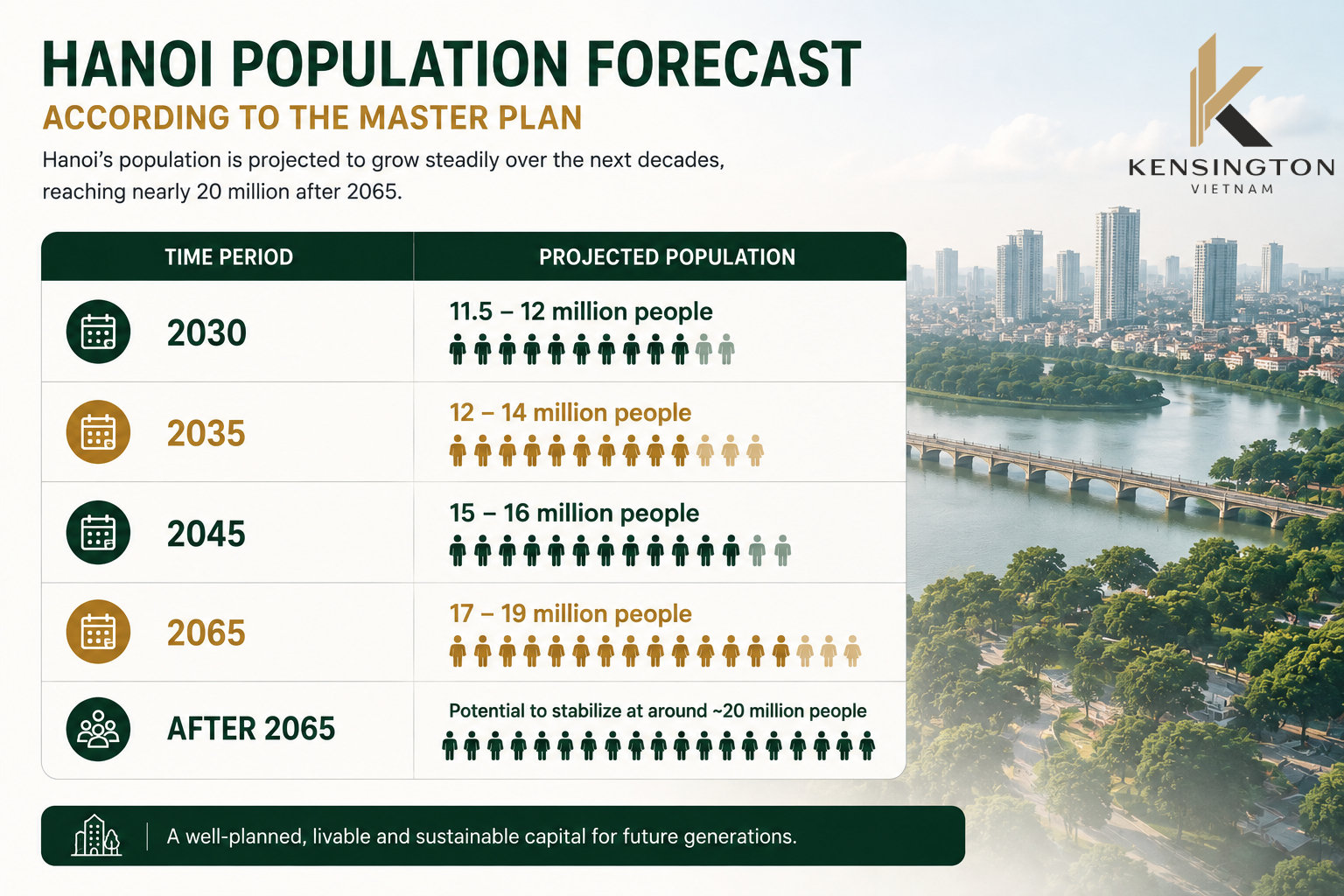
Beyond 2065, the focus shifts from rapid expansion to sustainable management maintaining a high quality of life while keeping population growth under control and ensuring infrastructure can support future generations.
4. Inside the Master Plan
The 100-Year Master Plan outlines how Hanoi is expected to grow, move, work, and live over the next century.
Metro & Transit-Oriented Development (TOD)
The future of Hanoi will be built around metro stations.
A planned 1,200-kilometer metro network will reshape how people move across the city. New mixed-use neighborhoods, offices, retail, and public spaces are expected to grow around stations, making public transport the backbone of future urban development.
Better connectivity, shorter commutes, and long-term opportunities for property investment.
Nine Growth Poles & New Urban Centers
Hanoi is moving beyond a single city center.
Instead of concentrating jobs and housing in the historic core, the master plan proposes nine strategic growth poles connected by transport infrastructure. Each is expected to develop its own economic role, creating a more balanced and resilient metropolitan region.
New business districts, reduced congestion, and broader investment opportunities across the city.
The Red River Transformation
Turning Hanoi's historic river into its greatest public space.
The Red River is planned to become a continuous waterfront featuring parks, cultural venues, commercial districts, and new mixed-use developments. Rather than separating neighborhoods, the river will connect them.
A more livable city, stronger tourism, and one of Hanoi’s most significant urban regeneration projects.
West Lake: Hanoi's Cultural & Luxury District
Where heritage, culture, and international living come together.
Already one of Hanoi’s most desirable neighborhoods, West Lake is expected to evolve into the city’s leading destination for culture, creativity, tourism, and luxury living. Landmark projects, including the future Quang An Opera House, will reinforce its international appeal.
A stronger global profile and continued demand for premium residential property.
A City Within a Forest
Growing greener instead of simply growing bigger.
The master plan introduces an extensive network of green belts, river corridors, ecological zones, urban parks, and forests designed to improve environmental quality while guiding future development.
Cleaner air, greater climate resilience, and a healthier urban environment.
The Underground City
Looking below the surface to unlock new urban space.
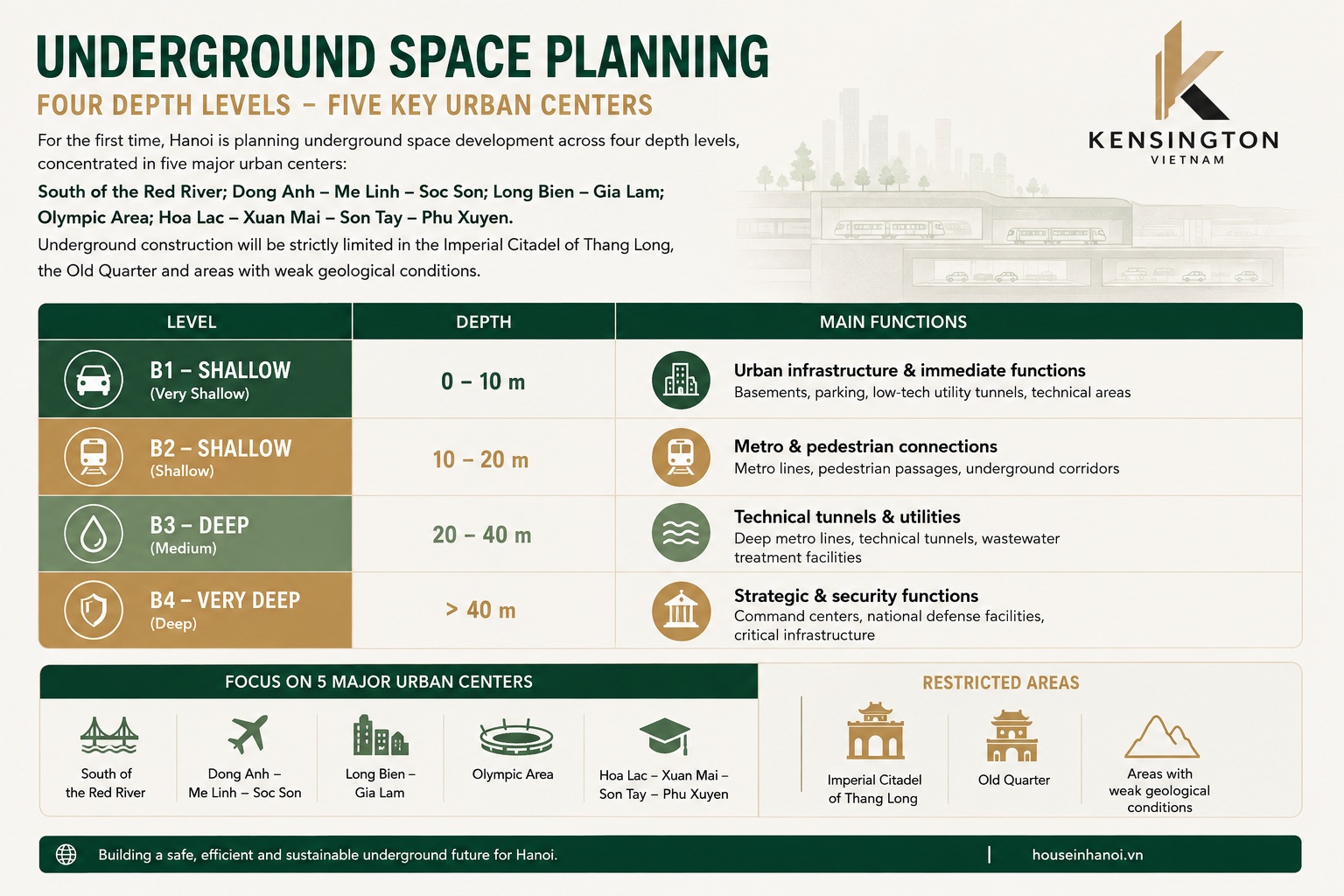
As Hanoi becomes denser, the city plans to expand underground infrastructure for metro lines, pedestrian connections, utilities, parking, retail, and public services freeing more surface space for parks and people.
A more efficient city with better public spaces above ground.
Airports, Ring Roads & Regional Connectivity
Building the infrastructure for a global capital.
The expansion of Noi Bai International Airport, a proposed second international airport, eight strategic ring roads, and new expressways will strengthen Hanoi’s position as Northern Vietnam’s primary gateway for business, tourism, and logistics.
Faster travel, stronger regional connections, and new economic growth corridors.
5. What This Means for Buyers, Investors & Businesses
The Hanoi 100-Year Master Plan is a long-term vision, not an overnight transformation. Many projects will take years even decades to complete. Even so, history shows that major infrastructure investments often begin influencing where people choose to live, where businesses expand, and where long-term property value is created long before construction is finished. Understanding the direction of a city can be just as important as understanding its current market.
For Homebuyers
The plan aims to create a city that is easier to live in. Future neighborhoods are expected to be better connected by metro, offer more public green space, and provide easier access to schools, healthcare, retail, and workplaces. Instead of relying on one crowded city center, residents will have more choices across multiple urban hubs.
- Transit-oriented neighborhoods (TOD)
- New mixed-use communities
- Improved public transport
- Better quality of life
For Property Investors
Infrastructure is often one of the strongest drivers of long-term real estate value.
New metro lines, transport corridors, waterfront regeneration, and emerging business districts could reshape demand across different parts of Hanoi over the coming decades. While no investment outcome is guaranteed, understanding the city’s long-term direction may help investors identify areas with stronger future potential.
- Metro expansion
- New urban centers
- Red River redevelopment
- West Lake transformation
- Airport growth corridors
For Businesses
A more connected city creates new opportunities.
The master plan aims to improve logistics, reduce travel times, and support the development of innovation districts, commercial centers, and industrial hubs. Businesses may benefit from improved access to talent, customers, and regional transportation networks.
- Office development
- Retail and hospitality
- Logistics
- High-tech industries
- International business services
5. FAQs
If a property is officially affected by a government-approved development project, the land may be acquired through Vietnam’s legal land acquisition process. In such cases, eligible property owners are generally entitled to compensation in accordance with applicable laws, which may include cash compensation, resettlement housing, or other forms of support, depending on the specific project and individual circumstances.
Yes.
The master plan includes the development of a second international airport south of Hanoi, while Noi Bai International Airport will also be expanded. Together, the two airports are intended to strengthen Hanoi’s role as an international gateway for business, tourism, and logistics.
Secure Your Property in Vietnam as a Foreigner
Our team helps international buyers identify legally compliant, high-performing properties from the start.
Tell Us
What You’re Looking For
Let us know your preferences, budget, and timeline, and we’ll help you find the perfect property in Vietnam quickly and efficiently.
Discover More
Whether you are looking for stable rental income or long-term capital growth, explore curated properties aligned with your investment strategy.
Top Investment
Locations
Explore the most sought-after locations in Hanoi, popular among foreign buyers and investors for their prime positioning, vibrant lifestyle, and strong growth potential.
You Also Want To Read
Explore practical buying guides, legal insights, and market knowledge designed to help foreign buyers navigate Hanoi real estate with more confidence and clarity.
Bac Ninh: An Investor’s Guide to Vietn...
Can Foreign Companies Buy Property in Vietna...