



Hanoi is being reshaped by two master plans approved in late 2024, the abolition of districts in July 2025, and bridges, metro lines and ring roads moving from paper to construction. For anyone buying an apartment or house, these plans matter as much as the floor plan: they decide where new roads, stations and parks will go. This guide explains Hanoi’s urbanization planning as it stands in late 2026, separates what is operating from what is under construction or only planned, and shows how to check a project’s legal and planning status before you buy.
The master plans that guide Hanoi’s urbanization
Two documents sit at the top of Hanoi’s planning system. The first is the Capital Planning for 2021–2030, with a vision to 2050, approved by the Prime Minister in Decision 1569/QD-TTg in December 2024. It covers the city’s whole 3,359.84 km² territory and targets a population of around 10.5–11 million by 2030. The second is the Adjusted General Master Plan of Hanoi to 2045, with a vision to 2065, approved by Decision 1668/QD-TTg later in December 2024, which turns those goals into land uses, transport corridors and density.
Planning does not stand still: in January 2026 the Hanoi People’s Council approved the core content of a new long-range plan with a 100-year outlook, and subdivision plans are being revised. The 2024 decisions remain the reference today, but details at block level can change, so check every purchase against the latest approved zoning rather than a brochure map.
A multi-centre city: urban zones and satellite cities
The 2045 plan moves Hanoi away from a single, overcrowded core toward a multi-centre region of five urban zones. Press summaries describe a northern city around Dong Anh, Me Linh and Soc Son, anchored by Noi Bai Airport, and a western city built on Hoa Lac and Xuan Mai as a science, technology and education hub. A southern city is also under study. The older five satellite towns have been reduced to two: Son Tay (culture and tourism) and Phu Xuyen (industry).
For homebuyers, large new townships in the north and west are consistent with long-term policy, but their schools, shops and transport will arrive in stages. The north of the Red River is where the biggest changes are visible, including the BRG–Sumitomo project we cover in our update on the Smart City project in Dong Anh.
The Red River urban axis
The Red River is the backbone of both plans. Its 1/5,000 zoning plan, approved in 2022 for around 11,000 hectares between Hong Ha and Me So bridges, has been under comprehensive revision since late 2025, and in May 2026 the Hanoi People’s Council approved the investment policy for a Red River Landscape Boulevard scheme combining riverside parks, redevelopment, resettlement and an underground metro line along the western bank. As of autumn 2026, site clearance has begun for the first park, while the revised zoning plan itself is still being finalised.
Treat this axis as planned. It will be delivered over many years and involves relocating riverside communities, so a specific plot or building near the dyke may be affected by future land acquisition, exactly the kind of risk the planning checks below are meant to catch.
Tay Ho and the northwest: the area this guide started with
When this article was first written in 2019, we focused on Tay Ho and the new northwest of the city. West Lake, more than 500 hectares of water, still anchors Hanoi’s most international residential area, with a long-established expatriate community, international schools and services. West of the lake, Starlake (Tay Ho Tay), the diplomatic quarter and the Ciputra township have since filled in with offices, embassies, villas and apartment towers.
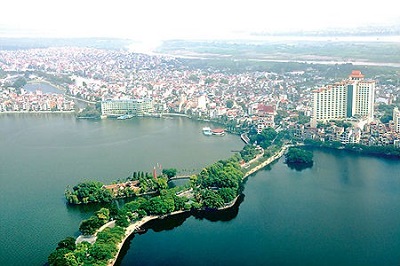
Since 1 July 2025, Tay Ho is no longer an administrative district: Hanoi removed its 30 district-level units and merged 526 communes and wards into 126. The old names are still used to describe areas, as we do here. Browse current listings in Tay Ho Westlake.

Infrastructure: operating, under construction and planned
Timelines often slip, so sort projects by their real status rather than announced dates.
- Operating: Metro Line 2A (Cat Linh–Ha Dong); the elevated section of Metro Line 3 from Nhon to Cau Giay, opened in 2024; Nhat Tan Bridge and the Vo Nguyen Giap road to Noi Bai Airport; the National Exhibition Center in Dong Anh, inaugurated in August 2025; and the first 15 km of the Ring Road 4 parallel road in western Hanoi, opened to traffic in October 2026.
- Under construction: the underground section of Metro Line 3 towards Hanoi Railway Station; Metro Line 2 from Nam Thang Long (near Ciputra) to Tran Hung Dao, which broke ground in October 2025; Tu Lien Bridge linking Tay Ho with Dong Anh, started in May 2025 with completion targeted for the end of 2027; and the remaining sections of Ring Road 4, which authorities aim to complete in 2027.
- Planned: the Red River Landscape Boulevard and riverside metro, Tran Hung Dao Bridge, and the wider urban rail network that the 2045 plan expects to grow to more than 400 km by 2035.

A station or bridge already under construction is a reasonable factor in choosing a location. One that exists only in a plan is a possibility, not a promise, and should not be the main reason to pay a premium.
How to check a project’s legal status and planning before buying
Most problems we see come from buying before a project is legally ready, or buying a plot whose planning was never checked. The current rules come from the Law on Housing 2023, the Law on Real Estate Business 2023 and the Land Law 2024, all in force since 1 August 2024. Before signing anything, ask for and verify:
- Planning information: the approved 1/500 detailed plan for the project, or for an individual plot, written planning information from the ward or commune People’s Committee or the city’s planning authorities. Online lookup tools are a first step, not a substitute.
- Project approvals: the investment policy decision, the land allocation or lease decision, the land use right certificate for the project and the construction permit.
- Eligibility to sell off-plan: for apartments sold before completion, the developer needs a written confirmation from the provincial housing authority that the units are eligible for sale, an acceptance record showing the building foundation is complete, and a bank guarantee offered to the buyer. Only once these conditions are met may the developer take a deposit, capped at 5% of the price.
- Foreign ownership room: foreigners may buy in commercial housing projects outside defence and security areas, up to 30% of the apartments in a building and generally up to 250 houses in a ward-level area, for 50 years with one extension. Ask how much foreign quota remains in your building.
- For resale units: the ownership certificate (pink book), or proof the seller’s contract can be transferred, and no mortgages or disputes.
Our guide to owning property in Vietnam as a foreigner covers the process in more detail. Rules change regularly, so have a Vietnamese property lawyer review the documents for any significant purchase.
Buying sensibly in a changing city
The plans make the direction clear: more growth north of the river and in the west, and the Red River turning from a barrier into a central corridor. They do not guarantee timing or prices. Buy what suits your own use and budget today, favour projects with complete legal documents and infrastructure that exists or is visibly being built, and treat anything further out as a bonus rather than the basis of the decision. For many buyers, a completed building in an established area offers more certainty than an off-plan unit. Compare options in our list of apartment buildings in Hanoi and second-hand properties for sale.
Frequently Asked Questions
Which master plans currently apply to Hanoi?
The Capital Planning for 2021–2030 with a vision to 2050 (Decision 1569/QD-TTg) and the Adjusted General Master Plan to 2045 with a vision to 2065 (Decision 1668/QD-TTg), both approved in December 2024.
Does Hanoi still have districts like Tay Ho or Dong Anh?
Not as administrative units. Since 1 July 2025 Hanoi has two levels of local government, the city and 126 wards and communes.
Which new areas does the plan prioritise?
The 2045 plan directs growth to a northern city around Dong Anh, Me Linh and Soc Son, a western city around Hoa Lac and Xuan Mai, and corridors along the Red River, with Son Tay and Phu Xuyen as satellite towns.
How do I check if an off-plan apartment can legally be sold?
Ask the developer for the housing authority’s written confirmation that the units are eligible for sale, the foundation acceptance record and the bank guarantee. Deposits, capped at 5%, are only allowed once these conditions are met.
Can foreigners buy in any new project in Hanoi?
Only in commercial projects outside defence and security areas, within the 30% per building and 250 houses per ward-level area limits. Confirm the remaining foreign quota before paying a deposit.